MAS*H the Way It Was Meant to Be Seen
When the TV series M*A*S*H was being produced, creators Larry Gelbart and Gene Reynolds didn’t want a laugh track. They were making a show about war, about surgeons trying to save lives in impossible conditions, and canned laughter felt… wrong. CBS studio executives disagreed. They’d never produced a comedy without a laugh track and weren’t about to start. The compromise? No laugh track during operating room scenes. Gelbart later said, “I always thought it cheapened the show. The network got their way.”
M*A*S*H Without the Laugh Track
When M*A*S*H released a DVD set that included a soundtrack option that removed the laugh track, I was enthralled. I heard so many lines that I’d missed because the laughter had drowned them out. If you haven’t watched M*A*S*H without the laugh track, it’s a whole different experience.
CBS relented and agreed not to use the laugh track in surgery, but surgery wasn’t the only place where the horror of war existed. The 4077th wasn’t a hospital that happened to be near a war, it was the war. The wounded arrived in waves. The dead were counted in batches. The futility and exhaustion and gallows humor weren’t confined to the operating room; they permeated every scene, every conversation, every quiet moment between the chaos.
And the laugh track cheapened all of it.
Without it, M*A*S*H becomes what it was always meant to be: a comedy about tragedy. The jokes land harder because they’re not punctuated by canned applause. The silences hit differently. You realize that Hawkeye’s wisecracks aren’t just punchlines, they’re survival mechanisms.
Upscaling Changes Everything
A few years ago, I got a tool that used AI to upscale video. I used it to upscale M*A*S*H, and it was transformative.
I suddenly saw all kinds of details that I hadn’t noticed before. Trapper John’s duffel bag has “John Francis Xavier McIntyre” stenciled on his duffel bag. Clear as day. I’d watched that scene a dozen times and never caught it.
There are numerous places where you can see things that were missed in the original broadcast. Little details that were always there, just buried in the grain and resolution limits of 1970s television.
Now, I know that you can watch M*A*S*H in “high def” on streaming now.
But that’s crap.
The Widescreen Problem
They made it 16:9.
You cannot take a show that was shot in 4:3 and make it 16:9 and call it good. When you do that, you’re either cropping the top and bottom (losing part of the frame) or stretching the image (distorting everything). Either way, you’re seeing maybe 60% of what was meant to be seen.
Friendsmostly got away with it, but even then, they went back to the original film and lost a lot of the DVD extras, extended scenes that had been included in the DVD releases but weren’t available in high-res for the widescreen transfer. And even with Friends, there are scenes where you can see the actors talking to stand-ins, or set dressing that was never meant to be in frame. The show was blocked and lit for 4:3. Anything outside that frame was never intended to be seen.
But of the shows I’ve seen so far, Friends is the only one that comes close to making the 4:3-to-16:9 transition work.
Seinfeld was famously ridiculed for their 16:9 treatment. When it hit Netflix in 4K, fans immediately noticed that visual gags were being cut off. In the episode “The Pothole,” the pothole, you know, the thing the episode is named after, doesn’t even appear in the widescreen version. It’s cropped out. Jokes were literally removed from the frame.
If a show was shot in 4:3, it’s okay to make it higher definition. But keep it in 4:3. That’s the aspect ratio it was designed for. That’s how the cinematographer framed it. That’s how the director blocked it. That’s what the audience was supposed to see.
My Version
My version of M*A*S*H is in 4:3. Upscaled. No laugh track.
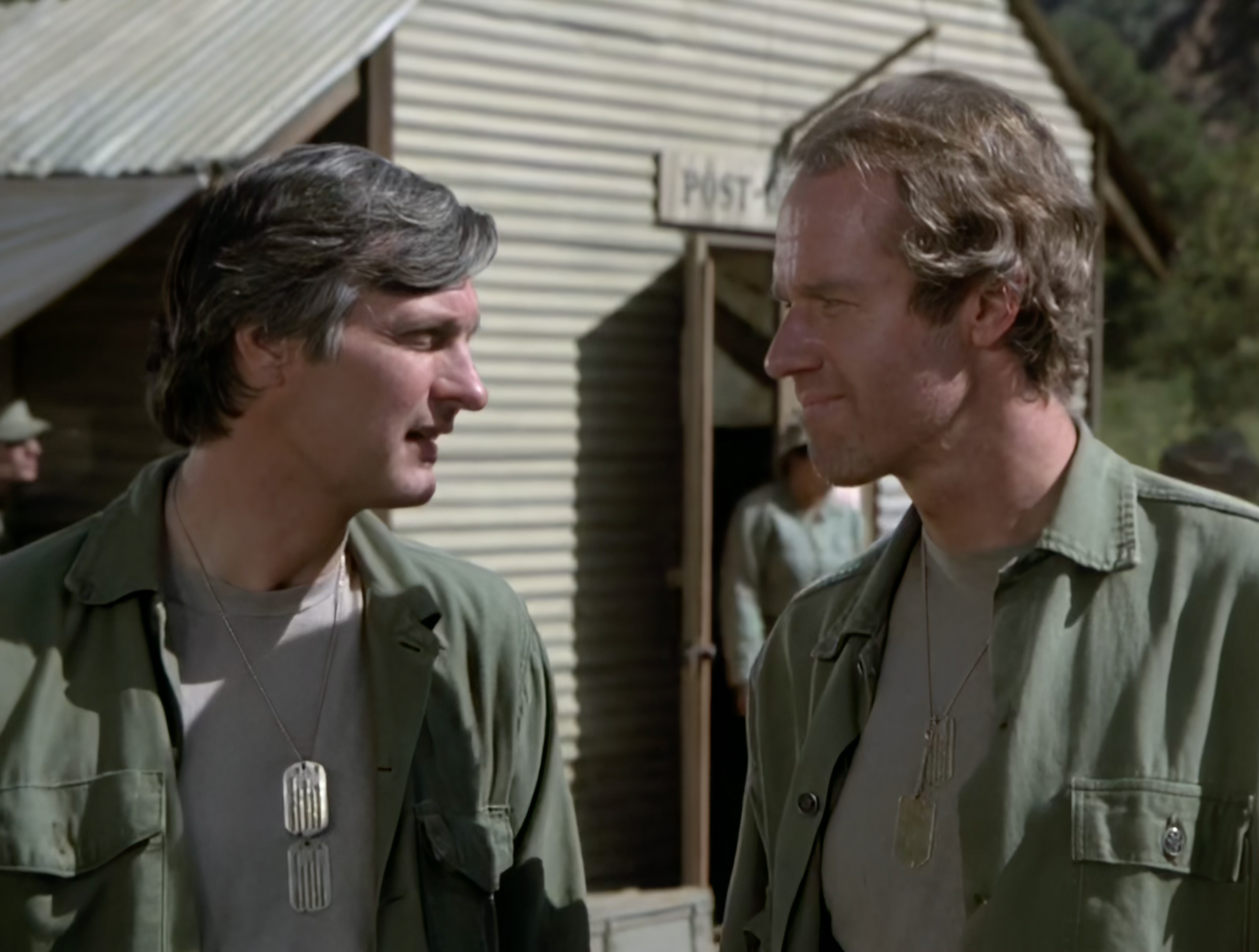
It’s how the show was meant to be seen, and I, and my friends and family who come over, are the only ones who can see it that way.
Every time someone watches it at my house for the first time, they’re surprised by how different it feels. The jokes are sharper. The drama is heavier. The details are visible. You’re not watching a sitcom with a laugh track awkwardly bolted on. You’re watching a war comedy, emphasis on both words, that respects its audience enough to let them decide when something is funny, and when it’s just sad.
Streaming services want everything in widescreen because it looks “better” on modern TVs. They want everything in 4K because higher numbers sell subscriptions. But in the process, they’re butchering the original intent, cropping out jokes, and covering up the flaws that were never meant to be visible in the first place.
I get it. Most people don’t care. They just want to watch the show.
But if you’ve ever wondered why Seinfeld feels off on Netflix, or why M*A*S*H doesn’t hit the same way you remember, or why you can see boom mics in the widescreen version of Friends, this is why.
Because 4:3 wasn’t a limitation. It was a decision.
And my version of M*A*S*H honors that decision. No laugh track. No cropping. Just the show the way Gelbart and Reynolds wanted you to see it.
Do you watch anything in its original aspect ratio? Or am I the only one who cares about this? Let me know in the comments.
 aucontrary