Smoke Detectors: The Rant Continues (Or, Be Careful What You Wish For)
The History
[With Continued Apologies to Dennis Miller]
Twenty-two years ago, I posted a rant on a now-defunct forum about smoke detectors. Seven years later, I reposted it on this blog because the situation had not improved. Now, in 2026, I’m here to report that things have both gotten better and spectacularly worse.
I don’t want to get off on a rant here, but if I’ve learned anything in the past two decades, it’s that the universe has a wicked sense of irony.
The Journey
When I moved to a new house, it didn’t have hard-wired smoke detectors. You’d think I would have been thrilled—no more Heisenberg uncertainty principle draining batteries that were supposed to be backups for a wired system! But no, building codes are a thing, so I needed smoke detectors.
I considered the fancy Nest ones. They were sleek. They were smart. They were expensive. And after my decades-long battle with smoke detector batteries, I was deeply concerned about trusting my life to something that relied entirely on batteries, no matter how “smart” they claimed to be.
So I tried Z-Wave detectors for a while. They would talk to my home automation system! They could send me notifications! The future had arrived! Except the future was flaky. They were hard to keep paired. Every time I changed home automation platforms (and oh, have I changed platforms), I’d have to re-pair them. Or try to re-pair them. Or curse at them while standing on a ladder trying to get them to pair.
Eventually, I settled on a compromise. Originally just three—one on each floor, like in the old days. But then a few years ago, I upgraded. I got the fancy ones. The ones that wirelessly link to each other. The ones that have voice announcements and know what room they’re in. Seven of them. One for each bedroom, plus the usual suspects.
And friends, this is where I need to tell you about the danger of getting what you wish for.
4:30 AM: A Cautionary Tale
Remember how in my original rant I asked for a smoke detector that would talk to me? That would say, “Excuse me Mr. Whitehead, but your batteries are dying, please add them to the shopping list”?
Well, at 4:30 this morning, I got my wish.
“THE KITCHEN SMOKE DETECTOR BATTERY IS LOW! PLEASE REPLACE THE BATTERIES!”
It SCREAMED it, because Smoke Detectors only have one volume. But, I still wasn’t sure what the heck it was. But then, because I have seven smoke detectors that are wirelessly linked, the others all wanted to share the news:
Hall: “THE KITCHEN SMOKE DETECTOR BATTERY IS LOW! PLEASE REPLACE THE BATTERIES!”
Bedroom: “THE KITCHEN SMOKE DETECTOR BATTERY IS LOW! PLEASE REPLACE THE BATTERIES!”
Other bedroom: “THE KITCHEN SMOKE DETECTOR BATTERY IS LOW! PLEASE REPLACE THE BATTERIES!”
Other other bedroom: “THE KITCHEN SMOKE DETECTOR SMOKE BATTERY IS LOW! PLEASE REPLACE THE BATTERIES!”
Other other other bedroom: “THE KITCHEN SMOKE DETECTOR SMOKE BATTERY IS LOW! PLEASE REPLACE THE BATTERIES!”
assume the basement one did too, but it was too far away for me to hear, which was the only mercy the universe granted me that morning.
Then, as if that wasn’t delightful enough, the kitchen smoke detector began its chirping. Remember chirping? That hasn’t gone away. Every. Thirty. Seconds.
It was a weekday, and on weekdays, I wake up at 5:30. But here’s the thing about getting woken up at 4:30: if you try to go back to sleep, your body says “nope, we’re sleeping until noon now, those are the rules.” So I laid there, listening to the chirp, counting the seconds between beeps (still thirty, after all these years), doing the math on how many chirps I’d hear before my alarm went off (120, if you’re curious).
At around 5:20, I gave up and dragged myself out of bed to replace the battery. And here’s where the engineers really outdid themselves. I put the new batteries in and:
“THIS IS A SMOKE DETECTOR! IT IS ASSIGNED TO THE KITCHEN! PRESS THE BUTTON TO CHANGE THE ASSIGNMENT!”
slight pause
“PRESS THE BUTTON TO TEST THE SMOKE DETECTOR!”
What a delightful way to start the day. I’m tired.
What I Wished For vs. What I Got
In my 2004 rant, I had some very reasonable requests:
- A clock that waits until 6 PM to alert me
- A motion detector that only beeps when someone is around
- Internet access to email me when batteries are low
- Cost no more than $19.95
What I got:
- Voice announcements (Careful what you wish for)
- At maximum volume (Nobody asked for this)
- At 4:30 AM (Also nobody asked for this)
- That wake up all seven detectors in series (DEFINITELY nobody asked for this)
- And cost way more than $19.95 (Of course)
You see, the engineers heard “talk to me” but apparently didn’t hear “use your indoor voice” or “wait for a reasonable hour” or “maybe check if I’m asleep.” Smoke detectors still only have one volume setting: EMERGENCY. Which, I suppose, makes sense for actual smoke, but seems a bit excessive for “hey, you might want to add AA batteries to your shopping list sometime in the next few days.” (You know, that IS one nice change, they’ve moved away from 9 volts to the much more common AA’s.)
The Setup Experience
I should mention that setting up these voice-enabled, room-identifying smoke detectors was about as much fun as you’d expect. Each one needs to be programmed with its location. And how do you program them? By holding down buttons while it screams at you about its various functions.
Remember, it only has one volume: EMERGENCY. So picture me, standing on a ladder, holding a button while this thing yells “THIS IS A SMOKE DETECTOR! PRESS THE BUTTON TO ASSIGN IT TO THE KITCHEN!” at full volume. Then the next one: “THIS IS A SMOKE DETECTOR! PRESS THE BUTTON TO ASSIGN IT TO THE KITCHEN!” <press> “BASEMENT!” <press> “HALLWAY!” <press> “BEDROOM!“
My neighbors must have thought I was running some kind of smoke detector training facility.
The Ten-Year “Solution”
Now, I know what you’re thinking: “Todd, there are smoke detectors now with ten-year sealed batteries! Problem solved!”
And you’re right! They exist! The battery lasts for ten years! Of course, most people live longer than ten years [citation needed], which means you still have to deal with this nonsense eventually. Plus, and this is the part nobody mentions in the ads, after ten years you have to replace the entire detector. (Although, something this important maybe that’s the longest you should wait before replacing them?)
So instead of dealing with a $8 battery every year or two, you get to deal with a $40-60 detector every decade. The engineers have successfully taken an annual minor inconvenience and turned it into a less frequent major inconvenience. This is technically progress.
But more importantly, you still have the core problem: that ten-year battery is going to start complaining at some point. And when it does, is it going to wait until 6 PM? Is it going to send you a polite email? Is it going to check if you’re asleep?
No. It’s going to scream at you at 4:30 in the morning. (And unless you happen to have a cupboard full of spare smoke detectors, your only choice until you get a replacement is to turn it off, and not have a detector at all.)
What I’ve Learned
In twenty-two years, I’ve learned that smoke detector engineers have mastered exactly one thing: making sure I know when batteries are dying. They have not mastered:
- Timing
- Volume control
- Basic consideration for human sleep cycles
- The concept that not all alerts require the same urgency level
- Reading product reviews from the last two decades
But mostly, I’ve learned to be very, very careful what I wish for. Because somewhere, there’s an engineer reading this right now thinking, “You know what would make this better? If the smoke detectors could detect when you’re in REM sleep and specifically alert you then, because that’s when you’re least likely to ignore them!”
And in 2037, I’ll be writing “Smoke Detectors: The Rant Continues (Part 3)” about how my smart smoke detectors now integrate with my sleep tracker to wake me during my deepest sleep for maximum alertness.
The Dream Lives On
Of course, what I’d still like to see is a smoke detector with:
- A clock that waits until waking hours to announce non-emergency alerts
- Different volume levels for “your house is on fire” vs. “add batteries to your shopping list”
- Integration with home automation that doesn’t randomly unpair itself
- An understanding that if I have six smoke detectors, they don’t all need to announce the battery status of the one in the kitchen
- The ability to send a notification to my phone like literally every other smart device in my house
- AI that can determine whether I’m awake before screaming at me (we have AI for everything else now, surely this isn’t too much to ask)
- And I’d still like it to cost no more than $19.95 (adjusted for inflation: $32.48)
But that’s just my opinion. I could be wrong.
I probably am. The engineers are already planning their next “improvement.”
I’m going to go take a nap now. If my smoke detectors wake me, I’m converting my house to sprinklers only.
Originally ranted in 2004 on LauncherXPlanet forums, reposted in 2011 on this blog, and continuing to be relevant twenty-two years later because some problems never die—they just get voice announcements.
MAS*H the Way It Was Meant to Be Seen
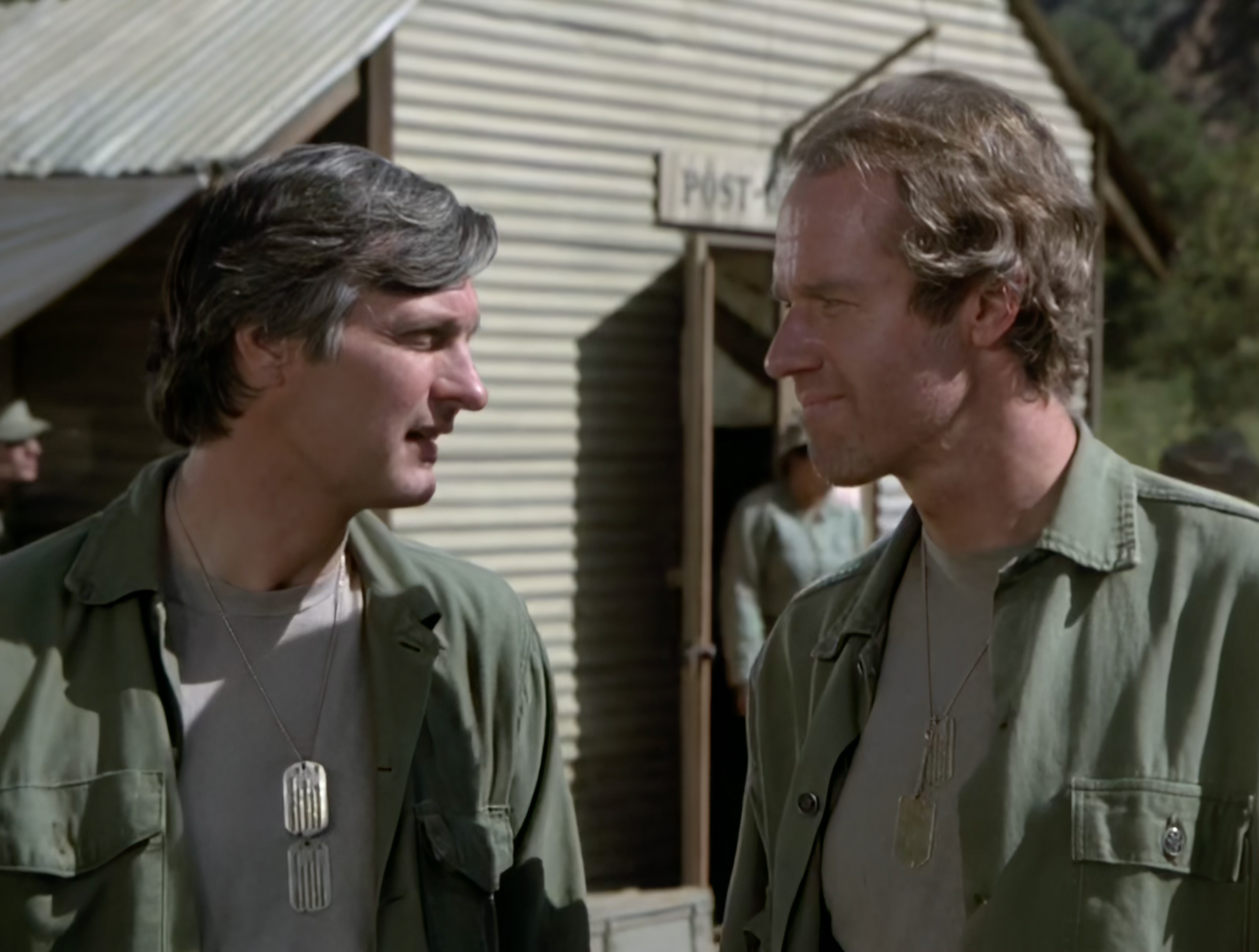
When the TV series M*A*S*H was being produced, creators Larry Gelbart and Gene Reynolds didn’t want a laugh track. They were making a show about war, about surgeons trying to save lives in impossible conditions, and canned laughter felt… wrong. CBS studio executives disagreed. They’d never produced a comedy without a laugh track and weren’t about to start. The compromise? No laugh track during operating room scenes. Gelbart later said, “I always thought it cheapened the show. The network got their way.”
M*A*S*H Without the Laugh Track
When M*A*S*H released a DVD set that included a soundtrack option that removed the laugh track, I was enthralled. I heard so many lines that I’d missed because the laughter had drowned them out. If you haven’t watched M*A*S*H without the laugh track, it’s a whole different experience.
CBS relented and agreed not to use the laugh track in surgery, but surgery wasn’t the only place where the horror of war existed. The 4077th wasn’t a hospital that happened to be near a war, it was the war. The wounded arrived in waves. The dead were counted in batches. The futility and exhaustion and gallows humor weren’t confined to the operating room; they permeated every scene, every conversation, every quiet moment between the chaos.
And the laugh track cheapened all of it.
Without it, M*A*S*H becomes what it was always meant to be: a comedy about tragedy. The jokes land harder because they’re not punctuated by canned applause. The silences hit differently. You realize that Hawkeye’s wisecracks aren’t just punchlines, they’re survival mechanisms.
Upscaling Changes Everything
A few years ago, I got a tool that used AI to upscale video. I used it to upscale M*A*S*H, and it was transformative.
I suddenly saw all kinds of details that I hadn’t noticed before. Trapper John’s duffel bag has “John Francis Xavier McIntyre” stenciled on his duffel bag. Clear as day. I’d watched that scene a dozen times and never caught it.
There are numerous places where you can see things that were missed in the original broadcast. Little details that were always there, just buried in the grain and resolution limits of 1970s television.
Now, I know that you can watch M*A*S*H in “high def” on streaming now.
But that’s crap.
The Widescreen Problem
They made it 16:9.
You cannot take a show that was shot in 4:3 and make it 16:9 and call it good. When you do that, you’re either cropping the top and bottom (losing part of the frame) or stretching the image (distorting everything). Either way, you’re seeing maybe 60% of what was meant to be seen.
Friendsmostly got away with it, but even then, they went back to the original film and lost a lot of the DVD extras, extended scenes that had been included in the DVD releases but weren’t available in high-res for the widescreen transfer. And even with Friends, there are scenes where you can see the actors talking to stand-ins, or set dressing that was never meant to be in frame. The show was blocked and lit for 4:3. Anything outside that frame was never intended to be seen.
But of the shows I’ve seen so far, Friends is the only one that comes close to making the 4:3-to-16:9 transition work.
Seinfeld was famously ridiculed for their 16:9 treatment. When it hit Netflix in 4K, fans immediately noticed that visual gags were being cut off. In the episode “The Pothole,” the pothole, you know, the thing the episode is named after, doesn’t even appear in the widescreen version. It’s cropped out. Jokes were literally removed from the frame.
If a show was shot in 4:3, it’s okay to make it higher definition. But keep it in 4:3. That’s the aspect ratio it was designed for. That’s how the cinematographer framed it. That’s how the director blocked it. That’s what the audience was supposed to see.
My Version
My version of M*A*S*H is in 4:3. Upscaled. No laugh track.

It’s how the show was meant to be seen, and I, and my friends and family who come over, are the only ones who can see it that way.
Every time someone watches it at my house for the first time, they’re surprised by how different it feels. The jokes are sharper. The drama is heavier. The details are visible. You’re not watching a sitcom with a laugh track awkwardly bolted on. You’re watching a war comedy, emphasis on both words, that respects its audience enough to let them decide when something is funny, and when it’s just sad.
Streaming services want everything in widescreen because it looks “better” on modern TVs. They want everything in 4K because higher numbers sell subscriptions. But in the process, they’re butchering the original intent, cropping out jokes, and covering up the flaws that were never meant to be visible in the first place.
I get it. Most people don’t care. They just want to watch the show.
But if you’ve ever wondered why Seinfeld feels off on Netflix, or why M*A*S*H doesn’t hit the same way you remember, or why you can see boom mics in the widescreen version of Friends, this is why.
Because 4:3 wasn’t a limitation. It was a decision.
And my version of M*A*S*H honors that decision. No laugh track. No cropping. Just the show the way Gelbart and Reynolds wanted you to see it.
Do you watch anything in its original aspect ratio? Or am I the only one who cares about this? Let me know in the comments.
In Defense of My Perpetually Broken Wrangler 4xe
I drive a 2025 Jeep Wrangler 4xe Willys in that classic ’51 green—heavily themed with M*A*S*H stickers, because if you’re going to lean into the military aesthetic, you might as well commit to the bit. And in the year I’ve owned it, this beautiful mess of contradictions has been recalled twice, bricked by a software update, and taught me more about the joys of surface rust than I ever wanted to know.
Stellantis is imploding. They just took a $26.5 billion write-down on their EV strategy—you know, the one they waited way too long to get into—and the quality issues are being blamed on the aggressive cost-cutting that preceded it. They fired engineers, offshored work, and then had to hire 2,000 engineers back in 2025 when everything started falling apart. It’s the corporate equivalent of throwing your toolbox out the window and then wondering why you can’t fix anything.
And yet, I love this truck.
The Recalls
Let’s get the bad stuff out of the way first, because there’s a lot of it.
In October 2025, Stellantis recalled 24,238 Wrangler 4xe PHEVs after an over-the-air software update bricked vehicles. Just… stopped working. Owners were stranded, had to get towed to dealerships, and some dealers didn’t even know what was happening. I didn’t install the update that weekend because word spread fast on the forums. Smart money said “don’t touch your Jeep this weekend,” so I didn’t. Crisis averted, but only because I was paying attention.
Then came November’s fire risk recall. Over 320,000 vehicles—basically every 4xe made between 2020 and 2025—had battery cells that could potentially catch fire. Even when parked and turned off. The fix? Park it outside. Away from structures. And don’t charge it. For a month.
So my electrified hybrid that I bought specifically for the electric range sat outside in the driveway like a very expensive lawn ornament, plugged into nothing, while Stellantis figured out how to not burn down my house.
This was, apparently, my first battery recall. I’m told this is part of the experience.
Welcome to Wranglers
Shortly after I bought the thing, I was installing running boards—because heated steering wheels and power everything don’t mean you shouldn’t have to hoist yourself into the cab—and I noticed surface rust. On the frame. On my new truck.
I texted a friend who drives a balls-out awesome lifted Rubicon, the kind with armor plating that’s seen more trail miles than most people drive in a year. Her response: “Yep. Welcome to steel-frame cars.”
That’s it. No pearl-clutching. No “take it back to the dealer.” Just the calm acceptance that if you buy a Wrangler, you’re signing up for rust, recalls, and the occasional reminder that this vehicle was never meant to be refined. It was meant to survive.
The Paradox
Here’s the thing that confuses people: my Wrangler has heated seats. And a heated steering wheel. And adaptive cruise control. And a plug-in hybrid powertrain that gets me 25 miles of pure electric range before the gas engine kicks in.
It also has:
- A frame that rusts if you look at it funny
- Body panels that gap like a teenager’s orthodontic work
- Wind noise at highway speeds that sounds like you’re in a wind tunnel
- A turning radius that makes parallel parking a meditation on patience
- Recalls that tell you not to park it in your garage
- Software updates that brick the entire vehicle
And you know what? That’s the point.
A Wrangler isn’t trying to be a Lexus. It’s not competing with the Mercedes GLE or the BMW X5. It’s a vehicle that evolved from the Willys MB—the tiny, utilitarian, go-anywhere machine that won World War II and then became the template for every civilian off-roader that followed.
The people complaining about quality issues and recalls are the same people who should be driving a Nissan Rogue Platinum. You want luxury? Buy luxury. You want a vehicle that will drive through a creek bed, shrug off a dent, and still get you home? Buy a Wrangler. But don’t expect it to apologize for what it is.
A Note on the Bronco
I need to address the elephant in the room—or more accurately, the shiny, too-pretty-by-half Ford in the parking lot.
The new Bronco has heritage, and I’ll give Ford credit where it’s due: they did build the GPW during World War II. That “W” stood for “Willys,” because Ford was building someone else’s design, but they built hundreds of thousands of them alongside the Willys MB. So yes, Ford has as much right to claim Jeep heritage as anyone.
But here’s the problem: the Bronco is too pretty. It’s too polished. It’s what happens when a marketing department gets hold of a heritage brand and decides to sand off all the rough edges. The Bronco wants you to think it’s capable, but it also wants you to feel good about taking it to Whole Foods.
A Wrangler doesn’t care about your feelings. It is capable, and it doesn’t need to convince you. It’ll get you to the trail and back, but it’s going to rattle your fillings loose and leak a little oil in the driveway while doing it.
The Fun Part Nobody Talks About
You know what all the recall notices and quality complaints don’t mention? How much fun this thing is.
Last summer, I pulled the doors off and drove around town like that. Just… no doors. Top rolled back, music up, nothing between me and the world. You can do that in a Bronco, but it’s just not the same. (How many doorless Broncos have you seen? Compare that to how many doorless Jeeps you’ve seen, I rest my case) You definitely can’t do it in your crossover. But in a Wrangler? It’s Tuesday.
People stare. Kids wave. Other Jeep owners give you the wave—you know the one, the two-finger salute off the steering wheel that says “yeah, we get it.” It’s ridiculous and impractical sometimes, you get caught in a huge deluge rainstorm and have to put on dry clothes when you get home, and I did it every chance I got.
Then winter came, and we got a foot of snow. Not the pretty, fluffy kind—the heavy, wet, “this is why people move to Florida” kind. The city hadn’t plowed yet. My neighbors were stuck in their driveways.
I put the Wrangler in 4-Low and drove through it like it wasn’t even there.
A foot of snow. Unplowed streets. Didn’t even slow down. The Jeep just… shrugged and kept going. No drama. No wheelspin. Just quiet, confident traction and the satisfaction of knowing that while everyone else was waiting for the plows, I was already at the coffee shop. I have a very steep 100-foot long driveway. The street I live on has “Ridge” in the name, I cannot leave my house without going down a hill (which means I have to go back up that hill when I come home), the Wrangler doesn’t even notice. It goes up my driveway with a foot of snow the same way it goes up it in August. It just defies gravity.
That’s the thing about a Wrangler. When everyone else’s car becomes a very expensive driveway ornament, yours becomes the vehicle that makes you the most popular person on the block. “Hey, can you give me a ride to—” Yes. Yes, I can. Hop in.
Why I Love This Mess
So why do I keep defending a vehicle that’s been recalled twice in a year? That I had to park outside for a month? That I couldn’t even drive one weekend because Stellantis couldn’t figure out how to push a software update without bricking 25,000 trucks?
Because the Wrangler 4xe is honest.
It doesn’t pretend to be something it’s not. It’s not trying to be a luxury SUV with off-road cosplay. It’s not hiding its rough edges behind seventeen layers of sound deadening and soft-touch plastics. It’s a Wrangler with a battery pack and some modern conveniences bolted on, and it makes no apologies for that.
When I slide back the top and pull off the doors—yes, you can still do that on a 4xe—I’m driving something that’s fundamentally the same as the vehicles that rolled off the line in 1941. Steel frame. Body-on-frame construction. Go-anywhere capability. The fact that it also has Apple CarPlay and regenerative braking is just… extra.
Stellantis is a mess. The recalls are real. The quality issues are documented. The rust is definitely real.
But when I’m sitting in the driver’s seat with the top off, doors off, nothing between me and the world but a roll cage and some MASH stickers, none of that matters. Because at the end of the day, I didn’t buy a Wrangler because I wanted a nice car.
I bought it because I wanted a Jeep.
And Jeeps suck. That’s what makes them awesome.
Have you owned a Wrangler? What’s your “welcome to Wranglers” moment? Let me know in the comments.
Protected: Gamenight TPK
My Digital Camera History
I’ve been using digital cameras for a long time. In the beginning, the quality wasn’t the best. My wife wasn’t totally impressed with the quality, but I liked the convenience and the easy way to keep my pictures backed up. So, for a while, we each had a camera and took our own pictures with our own camera. My daughter probably felt like she was being chased by Paparazzi. (Or she would have if she hadn’t been so young.)
Apple Watch: Check-in After a week
I’ve had the watch a little over a week now. Saturday, I ran into the first relatively major glitch. I got my watch while I was cutting the grass and finished cutting it wearing the watch, but using my iPhone for music. This past Saturday was the first time I cut the grass since I got the watch. I had loaded music onto the watch, I paired my Plantronics Bluetooth headphones to the watch and started cutting the grass without my iPhone for the first time in years.
Apple Watch Doesn’t NEED GPS: Use 1960’s Technology Instead
On July 9, 1985, I boarded a plane at Dayton Airport and few to San Antonio, Texas where I entered Air Force Basic (it’s hard not to type that as BASIC) training at Lackland Air Force Base. I spent 6 weeks there and then 30+ weeks at Keesler Air Force Base in Biloxi, Mississippi. I had taken the Armed Services Vocational Aptitude Battery and scored well enough to choose whatever field the base (I was joining the Ohio Air National Guard, so unlike regular Air Force enlistees, I knew where I was going to end up after I finished tech school) had an opening for. I decided to become an Inertial and RADAR Navigation Specialist. I would be maintaining and repairing navigation systems on LTV A-7 Corsair II Fighter jets. This jet first flew 2 years before I was born and the dates on the tails of the ones at our based ranged from 1968 to 1972. They weren’t exactly high tech (by 1985 standards) and are ancient by today’s standards. But, they had a technology that I’ve been hearing a lot lately, and, based on what I know about it from my Air Force training, I’m wondering if we are using the technology to its fullest potential.
Read more…
Apple Watch Additional Observations
Saturday, I posted about my first 24 hours with the Apple Watch. Since then, I have a few more things to note about how it works.
24 Hours of Apple Watch
After the first 24 hours of owning an Apple Watch, I thought I would put down some of my initial impressions.
How to Keep Gmail, but Not Actually Use it
I’ve been using Gmail since it was first introduced. I’ve had my own domain since 1996, and in 2000, registered a second domain.
When Google introduced the Google Apps product, I moved my mail for both domains to it. I still have grandfathered free accounts there. So, all of my mail goes through these two domains. I have an account on both of them, but I forward one to the other and only ever really set one of them up in my mail clients. I’ve been pretty happy with the Gmail service until I got my new iPhone 5s.
Read more…